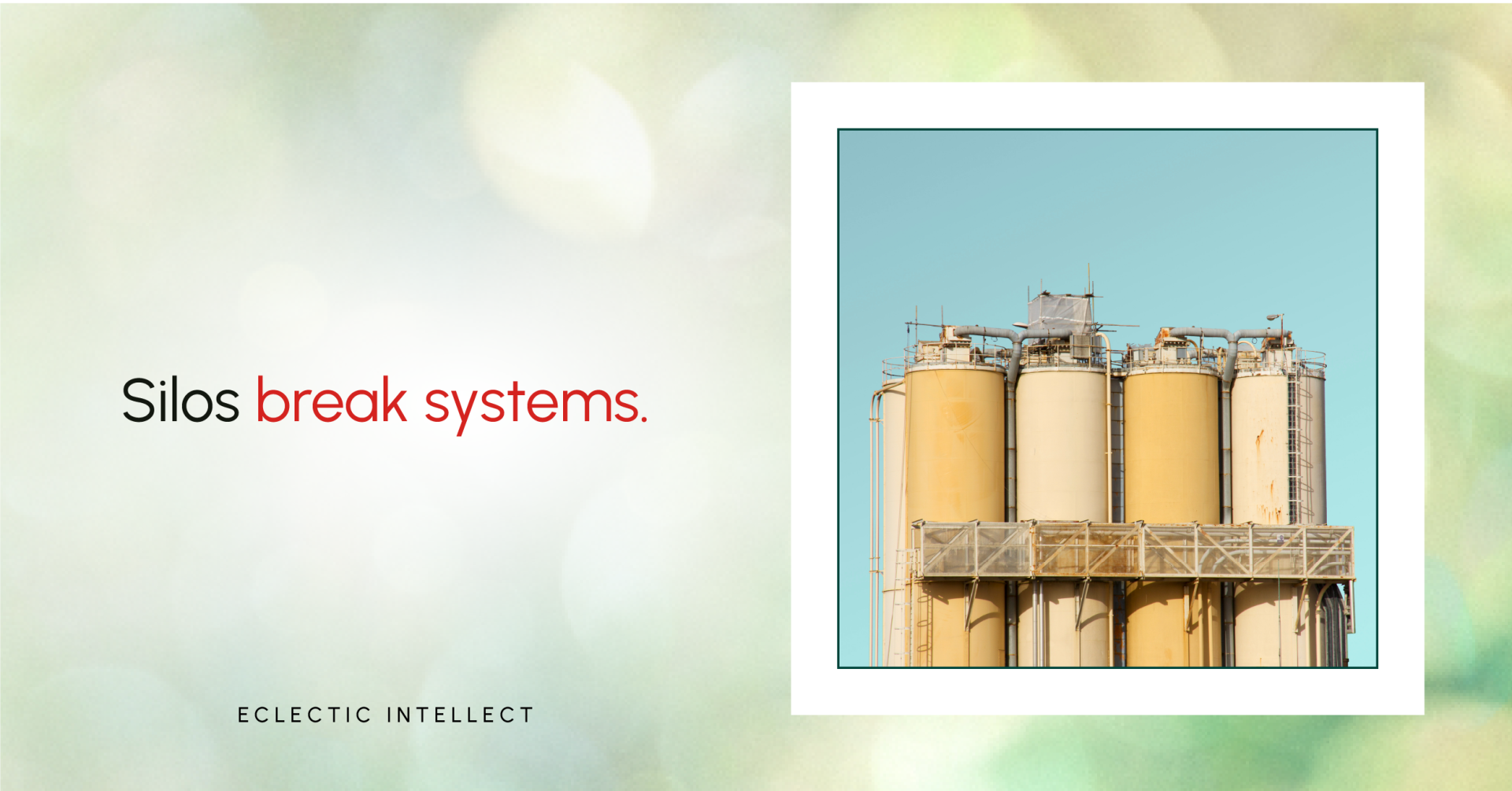
The artificial boundaries that humans impose on professions, concepts, technologies, devices - even each other - are useful in some ways but carry a dark curse.
As a consequence of their existence, each boundary we impose will inevitably degrade our awareness of the rich analog bonds that connect that region to other portions of the real world, and replace that understanding with a sparse handful of digital principles and practices that are easy to ignore and vulnerable to constraints, misunderstanding, and political whim.
The consequences of the resulting drift from reality can range from stress and inefficiency to total failure of the system we seek:
-
When a Sales organization acts purely in its own self-interest, it sells more widgets that quarter but may do so in a way that is impossible to deliver profitably.
-
When Service is optimized to minimize current cost, they hit financial targets but poison the market.
-
When Engineering makes every design elegant and bulletproof no one can afford to buy the solution.
-
When Project Management defines success as reaching dates instead of completing milestones you have only the illusion of progress measurement.
Everything we think of as our systems of interest in daily life are already
subsystems of subsystems of subsystems.
Imposing any further interface overhead is counterproductive.
You don’t really want Sales, Engineering, Project Management, and Service, you want the overall objectives of the organization to be met by controlled interaction of these skill sets. What they are called in your organization is irrelevant, but pretending they are independent is folly. Like human organs, you need all of them healthy, and all of them working together, to thrive.
When a group of cells decides to reproduce independently of the best interests of the patient, the medical term is
Cancer.
Cancer draws sustenance from the host, rewires immune system behavior to prevent detection / attack, disrupts relationships of all kinds and dumps toxins into the system. What was once part of you becomes a dangerous competitor intent on its own survival.
Silos exhibit disturbingly similar self-preservation instincts.
Cancer also metastasizes, spreading harm throughout the host. What at first was easily curable – and possibly went completely unnoticed for years – can quickly become difficult, then ultimately impossible to manage as it spreads.
Once again, the
parallels are stark. Silos in one area lead to competing fiefdoms arising throughout the kingdom.
The Sales and Service connection that retained customers for generations devolves into two competing organizations the minute one throws the other under the bus in front of senior management. Likewise Quality and Finance go to war over whether products are conforming and should count as revenue. Everyone goes to war with Project Management, even Engineering, as arguments regarding credit, blame and responsibility arise.
A portion of this is simply due to the architecture of systems.
The smaller the pieces, the greater the number of interface boundaries that are introduced. Worse still, the relationship between them is exponential and interface management overhead quickly dominates any potential benefit of isolation.
In effect, silos are a form of “performance enhancing drug” that creates benefit in one dimension but introduces a known system carcinogen as a by-product. Like many drugs, the benefit is near term and the penalty delayed. It’s also common that one party benefits and another pays the price, creating a false sense of safety and a path to dependency.
There should be a good reason to accept that risk of addiction and harm. At the absolute least Silos should be introduced very cautiously, remain closely monitored at all times, and system-level harm should be anticipated.
Where silos have the least risk and can actually bring potential benefit is in cases where there is intense concentration of skills within a region but very limited external connectivity required. The greatest risk arises when the result you seek depends upon rich connectivity of people and viewpoints.
When the goal actually is to impose isolation, such as in a security model, the “anti-system” property of silos becomes highly desirable.
Realizing that silos are a proven tool for preventing (unwanted) systems from functioning offers great insight into why you shouldn’t build them into the middle of organizations that need to work together.
It’s like putting rat poison in your sports marketing affiliated breakfast cereal.
Empty space, drag to resize
It isn’t a question of whether silos break systems, but instead:
“Do you really want to break your system, how much damage did you actually do, and what fraction of that damage can be mitigated through interface definition?